Interpreters Tell the Story from The Interpreter Diaries
September 15, 2012 Leave a comment
Interpreters Tell the Story from The Interpreter Diaries
Designed to provide online courses, CEUs, professional networking, and job opportunities for ASL Sign Language Interpreters nationwide.
September 15, 2012 Leave a comment
Interpreters Tell the Story from The Interpreter Diaries
August 25, 2012 Leave a comment
Article by Blair Tellers Staff Writer for Gilroy Dispatch, Gilroy, CA.
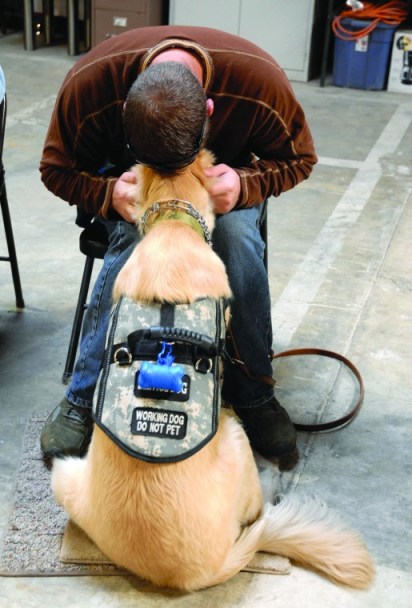
Operation Freedoms Paws
Recall the worst dream you’ve ever had.
Now consider reliving it. Monthly. Weekly. Nightly.
“Imagine you’re asleep, and you’re getting into this horrible nightmare that you dread getting into. And you can’t get out of it. It’s like you’re wrapped in cellophane,” described Gilroyan Don Baer, 65.
After 19 months in Vietnam, the U.S. Army veteran experienced violent nightmares that caused him to unintentionally hit or kick his wife in his sleep.
Having someone – or in this case, some animal – poised to pull you from the dark, psychological recesses of the subconscious and back to a state of grounded reality, said Baer, draws the line between exhausting insomnia and mental wellness.
“The dog senses this chemical change and restlessness in bed,” he said, lauding one of myriad skills of specially trained service dogs. “You come out of this horrible, rotten experience, and what do you see? Unconditional love, looking at you in the eye.”
Baer is the president/CEO of Operation Freedoms Paws, headquartered at 777 First St. in Gilroy. The 501 (c3) nonprofit has 53 teams enrolled in the program, which guides owners through the process of training their own service dogs.
Mary Cortani, 54, an Army vet of 14 years; former Army Master Instructor of Canine Education; and recent recipient of the Red Cross Heroes Award for her rehabilitation work with discharged soldiers, founded the program in 2010.
OFP hand-picks dogs from local shelters, then matches a dog to a compatible veteran. Many who go through the program struggle with issues such as post traumatic stress disorder or traumatic brain injury.
Jeremiah Gaches, a Lodi resident, said having his 2-year-old German Shepherd Rocky by his side “helps me get out into the community.”
Whereas the 34-year-old once isolated himself by hibernating in his “safe place” – at home and in bed – the Army veteran of three years who served in Korea and Iraq now “is able to talk to people. I used to have a big problem with people looking at me eye to eye.”
Cortani said service animals such as Rocky instill confidence; reduce stress levels; encourage independence; help a vet sleep peacefully; can be taught to detect oncoming diabetic shock; assist with limited mobility issues or enable their hypervigilant owner to enjoy public outings. It takes a dynamic, 32-week training regime commitment from each team to instill the foundations of a synergistic bond; the results of which, several veterans say, have transformed their lives.
“I have to take meds, but meds don’t do what the dog does,” said San Jose resident Matthew Cox.
The candid 38-year-old with a wry sense of humor served for 13 years in the Army, seven or eight of which were spent deployed in conflict.
He said his missions were to search, destroy and “find the leader of the bad guys.”
For the divorcee and father of two who at one point separated himself from his family “because it wasn’t safe for me to be around the kids,” Cox said being responsible for taking care of a dog was a step towards taking care of himself.
“If I had to pay him,” said Cox, looking down at a glossy golden retriever named Murphy resting contentedly at feet, “I’d be broke. In a whole, he’s my best friend … he made me who I am today.”
Likening her approach to a Chinese proverb (“If you give a man a fish, they’ll eat for a day. Teach a man to fish, he’ll eat for a lifetime”), Cortani said service dogs help vets address emotional wounds “they’re going to have to live with every day.”
Training the dog is the easy part, she said, “the hard part is training the person.”
After becoming a certified service animal, each dog receives additional training that tailors its abilities to its owner’s needs.
Baer, for example, who lost 40 percent his hearing while serving in Vietnam, has a yellow Labrador Retriever named Katie that acts a four-legged alarm clock. She gets her master’s attention when there’s a knocking at the door, or a ringing of the telephone.
Leona Herod, a firefighter in the U.S. Air Force who was stationed in Texas and England from 1979 to 1983, calls her long-haired service Chihuahua “the most beautiful animal in the whole wide world.”
When asked how long she served, Herod’s response was instantaneous and mechanical:
“Three years, seven months, 28 days.”
For the 52-year-old veteran overcoming PTSD, her pint-sized companion is trained to “watch my back.”
Through a tactic called “obedient disobedience,” service dogs learn to sense when their owners become anxious or stressed; reacting instinctively in a way that gets their owner’s attention.
“When I’m upset, she notices that, and she’ll slow down,” said Herod as she stroked the sleeping Chiwi – a caramel-colored mop of soft fuzz dozing in Herod’s arms. “She doesn’t respond when I’m like ‘come on, come one, let’s go!’”
Cortani is quick to clarify: “These are not companion dogs. The companionship they provide is at a level the average pet owner is not going to recognize.”
Rather, “we’re talking about invisible wounds, here.”
People such as Leod, Cox and Gaches appear to be normal, said Cortani, but stressors from past deployments cause them to deal with the every day world a little differently.
Chiming in on this, Herod said “it’s true, that joke they say: ‘How many veterans does it take to screw in a light bulb?’
The answer is, “you weren’t there. So you wouldn’t know.”
Activities regular civilians take for granted are out of the question, said Cortani, exampling trips to the supermarket or going to a movie.
“Fourth of July,” added Cox.
Military personnel, he explained, are trained to hone in on the minutiae of their surroundings, which makes simple trips to Wal-Mart or a leisurely outing at Pier 39 in San Francisco entirely unappealing.
Cox described hyper-vigilance as “constantly watching everybody’s facial language, constantly categorizing, picking out what could be a threat, what’s not a threat, asking, ‘What’s my way out?’ ‘What is my intention of being here?’”
Leod compares the ordeal to being at a fair, where targets randomly spring up from game booths and “you have to shoot at them.”
“I don’t know which one is going to come get me first,” she said. “I have to be so attentive that it just drains me to a point where I’m exhausted, completely.”
It’s these types of inner, psychological battles service dogs empower their owners to coexist with, Cortani said.
“They don’t have to be vigilant,” she said. “The dog is going to be vigilant for them.”
With a soaring success rate and growing interest, Cortani has been asked to expand OFP to four other parts of the U.S.
The only holdup is funding. Baer said it takes about $5,000 a month to cover OFP’s operating expenses, which includes providing dogs and services to vets at no cost.
Gaches attested to the difficulty of getting in to this type of program, of which there are so few.
“I tried to get into other service dog programs, but didn’t have any luck,” he said. “They were too crowded, or there weren’t enough dogs, or you would have to get on a waiting list. And some places just didn’t contact me back.”
Staring down at Murphy, Cox said having an 80-pound golden retriever shaking the bed at 6 a.m. gives him a reason to get up every morning.
“There are no amount of words I can say for what I’ve got laying at my feet,” he said. “There is no cost or value to these guys.”
For more information on Operation Freedoms Paws go to this LINK
August 21, 2012 Leave a comment
It took me two years before I’d let this much of myself show.
My bottle blonde hair
and palette of cosmetics
usually help me blend in with the other moms
who drive their children to sporting events
on a warm summer afternoon.
I turn the wheel,
hoping to avoid the stark reflection
that stares back in the rearview mirror.
A profile of me with the low ponytail says it all:
There is something different about me.
I am wearing hearing aids.
This is who I am.
I am slowly going deaf.
This was meant to happen,
to help me hear beyond what comes through
flawed ears.
– From the poem ‘Different’ by Lipreading Mom Shanna Groves
~*~*~*~
What do you think of my hearing aids?
August 17, 2012 2 Comments
The following story is from The New York Times, The Opinion Pages, Op-Ed Contributor – Sound Bites – By KATHERINE BOUTON
“NO one told me it was going to be this noisy,” says a young woman who is going deaf in Nina Raines’s play “Tribes.” If you have a hearing aid, the world is, paradoxically, far noisier than it is for a person with normal hearing. The human ear is a miraculous thing. It can filter out the roar at Madison Square Garden while homing in on the voice of the person in the next seat. A hearing aid can’t do that. The only way to really filter out noise is simply to turn it off.
Americans are increasingly aware of the dangers of noise, the single largest cause of hearing loss, but we are less aware of the way it further handicaps those of us who already have hearing loss.
I began to lose my hearing in my early 30s, for reasons no one has been able to determine. My hearing loss is progressive, and in 2002 I finally gave in to the inevitable and got hearing aids. I bought new ones — at $3,000 apiece, with little or no insurance reimbursement — every two or three years as my hearing deteriorated. Three years ago, when a hearing aid no longer helped in my worse ear, I got a cochlear implant, the height of hearing technology. I hear well enough now that I’m unlikely to get run over by a car coming up behind me. But, like the hearing aid in my other ear, the implant is nowhere near as good as a human ear — either for hearing or for filtering out what I don’t want to hear.
In a noisy environment like a restaurant, a person with normal hearing will still be able to hear his companion. But in that same environment, a hearing-impaired person will hear chairs scraping, dishes clanking, waiters shouting, all of it bouncing off the high ceilings, the bare walls, the chic metallic tables and chairs — an anxiety-provoking wall of noise. Worst of all is the restaurant’s background music, sometimes competing with a different sound track throbbing in the kitchen.
Earlier this week I had dinner with my husband and sister (both with normal hearing) and my daughter, son and niece, all 20-somethings, in a popular Brooklyn restaurant. It was my birthday and I had a great time, enjoying my family and the good food, but I didn’t hear one word said at the table. My daughter occasionally texted me a shorthand version of the conversation.
When my hearing loss was more moderate, I’d simply take off my hearing aid if it got too loud, setting it on the edge of the plate or on the table. But that can lead to unfortunate results. The ex-husband of a friend once popped his into his mouth, thinking it was a piece of bread. The best solution is to eat with just one or two other people, both facing you, so that you can supplement the sounds you hear with what you see. That’s enough to keep a social conversation going. If I really must hear what the other person is saying, I schedule the meeting in an office or at home.
Even for those with normal hearing, dining and talking are becoming mutually exclusive. Noise is the second most common complaint about restaurants, according to Zagat, following poor service. The first thing that anyone asks me when I say I’m writing a book about hearing loss is whether I can recommend a quiet restaurant. Booths, tablecloths and carpeted floors are a good start. A corner table helps. Sit with your back to the wall.
Noise causes hearing loss, and hearing loss itself is bad for your health. There are 48 million hearing-impaired Americans, over 15 percent of the population. Those affected include teenagers (nearly 20 percent of whom experience some level of hearing loss), people ages 19 to 44 (the most common period for the onset of hearing loss), and the elderly. Hearing loss is itself associated with depression, dementia and even heart disease.
Some researchers speculate that what we think of as age-related hearing loss is merely the accumulated damage of a lifetime of noise. Studies in Sudan and Easter Island in the ’60s and ’80s, respectively, have found populations where age-related hearing loss seemed nonexistent or limited. Though there may be genetic explanations, there was a marked difference between the hearing of Easter Islanders who had lived only on the island and those who had spent some years on the industrialized mainland.
I’m the first to acknowledge that noise has its place. What would “Bring In da Noise, Bring In da Funk” have been without the percussive clatter of those tapping feet? Who wants to go to a sports event where the crowd is silent? The stomp of a tyrannosaurus in Sensurround, the excited din of a good party, the bustle of a popular restaurant, the audible energy of a city. Noise is an integral part of any of these. But it can still be noisy without being literally deafening.
We need to quiet things down a bit for everyone, but especially for those who are already deafened. Webster’s defines noise as sound “that lacks agreeable musical quality or is noticeably unpleasant.” That’s a subjective definition. What’s music to your ears is almost always noise to mine.
Katherine Bouton, a former editor at The New York Times, is the author of the forthcoming book “Shouting Won’t Help: Why I — and 50 Million Other Americans — Can’t Hear You.”
Direct link to this article HERE
August 14, 2012 Leave a comment

Phoebe Tay
The more Deaf people I meet out there in the community, the more aware I am of the different life experiences of people growing up deaf and establishing a Deaf identity. Some Deaf kids are born to Deaf parents and develop Auslan as a first language, while there are many others who are born to hearing parents with little or no knowledge of Auslan and Deaf culture.
Andrew and Craig share their contrasting stories of growing up deaf in their respective families, and despite their background differences becoming the very best of friends.
Meeting
The two boys first met each other in a mainstream primary school in 1987 when Andrew moved from Melbourne to the Gold Coast. Being new, Craig showed Andrew around the school grounds. One morning Craig asked Andrew to play cricket while they were waiting for the first morning school bell. From then on, they developed a love for playing cricket and often played the sport together.
Different Deaf eyes
Andrew realised the obvious differences he and Craig had in their communication styles. Andrew’s first language was Auslan as all his family could sign. On the other hand Craig’s family used speech to communicate with each other. Craig used, and continues to use speech and Signed English as his main modes of communication. Signed English is a sign language that is different from Auslan.
While it is common for people of similar backgrounds and common interest to connect together, it was this difference that helped them to forge a close knit friendship.
Andrew initially faced challenges adjusting to his new school environment because it was his first time in a mainstream school. Before moving to the Gold Coast he went to schools specifically for Deaf children.
I was nervous when I first stepped into my new school. I wondered how I was going to connect with my hearing peers. There were only two of us boys in the class. The rest were girls who were younger than us. Craig showed me hearing ways of communicating and behaving. Eventually, I settled well into the school, says Andrew.
Culture shock
Andrew recalls his experience of going to Craig’s birthday party for the first time.
I remember going to Craig’s house to celebrate his 11th birthday. I met all of Craig’s friends for the first time. I was very nervous and shied away from the group because I realised that they were all hearing. I did not know how to interact with them.
Craig’s mum tried her best to encourage me to mix with the group and even asked me to go for a swim by the beach with them. His mum realised that I was Deaf like Craig but I lacked the oral skills needed to communicate effectively with hearing people, says Andrew.
Craig adds, Yeah, at my birthday party, I was signing and talking the whole time. I was trying to bridge the gap between Andrew and my hearing friends.
Bridging the differences
When Andrew and Craig moved on to high school, their friendship continued.
Craig picked up sign language from interacting with Andrew and his family, which opened his eyes to Deaf culture. His knowledge of Auslan improved. Meanwhile Andrew was also learning how to effectively lip-read and communicate with hearing people by watching Craig and his family and talking to them.
Throughout their high school years, they communicated effectively and developed a good understanding of one other. They would later became housemates during their university years.
Unbreakable bonds of friendship
Andrew says a quote by C.S Lewis aptly describes his friendship with Craig. Friendship is born at that moment when one person says to another, What! You too? I thought I was the only one.
Andrew now lives in Melbourne, Craig is still on the Gold Coast. When Craig visits Andrew and meets Andrew’s Deaf friends who use Auslan, Craig says his understanding is scattered because he is so used to thinking in English grammar and structure and Auslan is very visual. He often looks to Andrew to interpret or clarify what other Deaf people are signing to him. Craig jokingly comments Andrew helps him in those situations by becoming his interpreter. Andrew light-heartedly replies back, Not his interpreter, but his best friend. At this, Craig chuckles.
The men have encouraged each other’s personal growth as individuals and prove the bonds of true friendship are indeed unbreakable even when people live some distance from one another.

Craig left and Andrew right


 terpstube